
Our research focuses on the application of novel optical phenomenon for the development of advanced imaging techniques.
Research in progress
- Single molecule imaging
- Total Internal Reflection Fluorescence Microscopy (TIRFM)
- Structured Illumination Microscopy (SIM)
- Physical optics simulation
Single molecule imaging

Clathrin-coated structures are the best characterized endocytic carriers, but the mechanism through which clathrin-coated plaques perform endocytic functions had been debated. We developed novel experimental and analytical approaches that allow us to dissect the mechanism of plaque growth and disassembly with high spatial and temporal resolution. We found that clathrin and its primary adaptor protein (AP2) are likely to be incorporated to the plaques at the peripheral regions. Patches of clathrin coats are internalized also from the peripheries. Our results show that the peripheral regions of plaques are active endocytic sites, whereas the central regions are more stable.
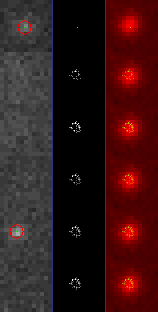
Single molecule detection events and localization of AP2 on the plasma membrane. (left) acquisition of imaging AP2-GFP (middle) construction of the single molecule image by addition of localizations of each detection events (right) overlay of single molecule image and diffraction-limited image (red)
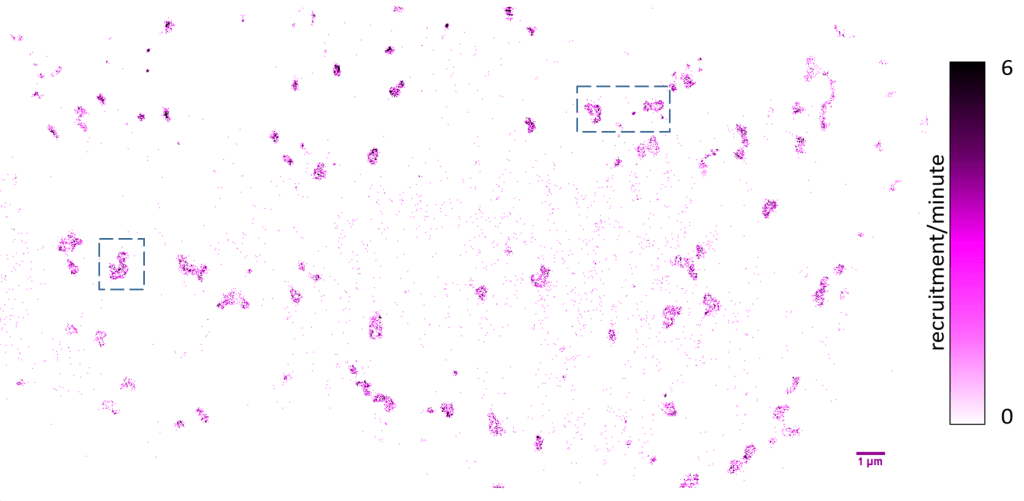

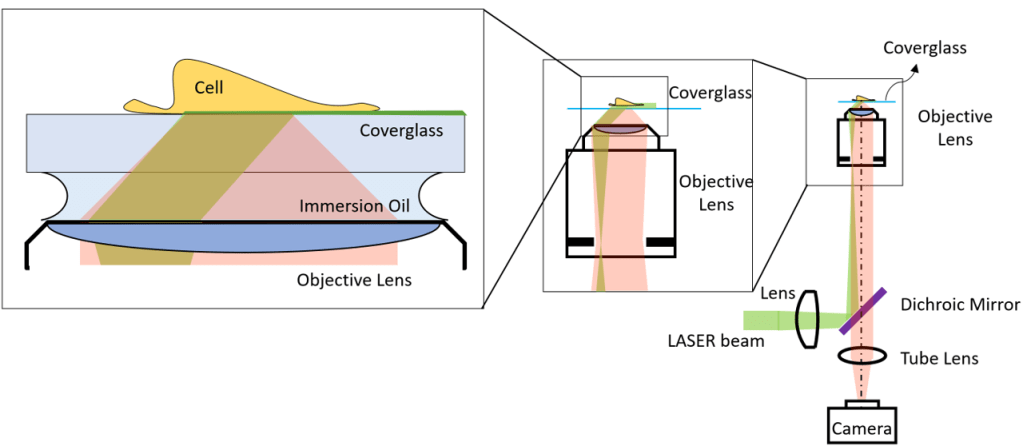
Total Internal Reflection Fluorescence Microscopy (TIRFM)
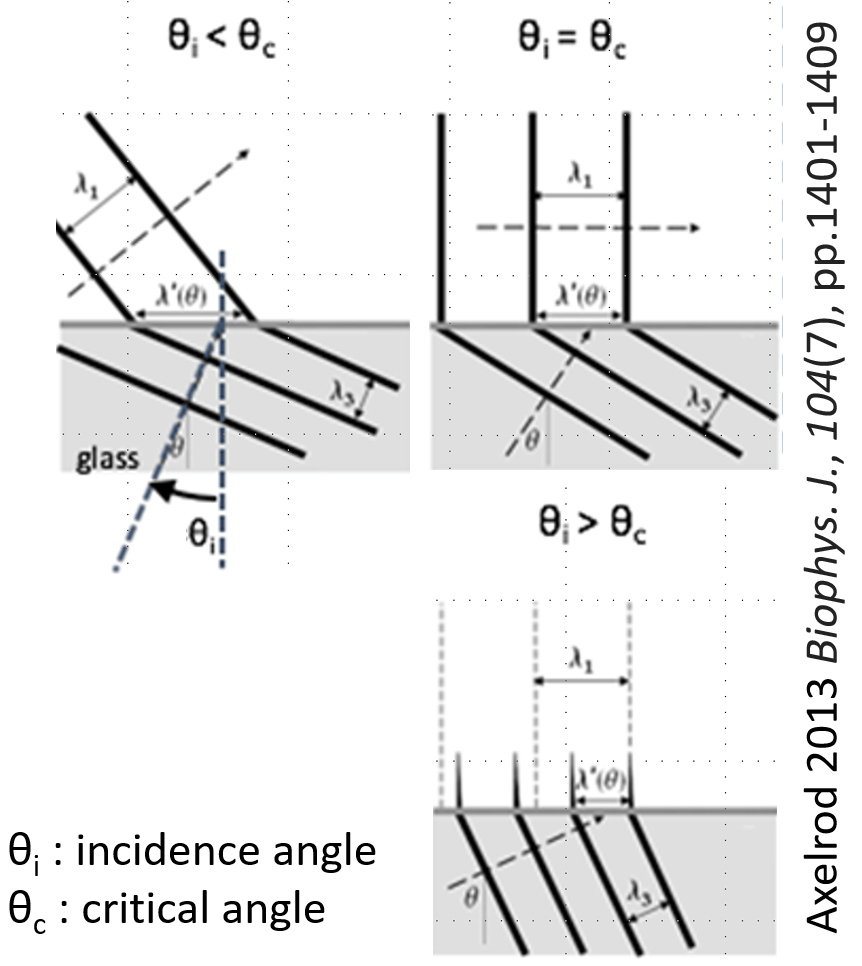
Evanescent waves arise from the electromagnetic boundary conditions at the interface between two optical media during total internal reflection (TIR). The evanescent field propagates parallel to the interface with an effective wavelength that depends on the angle of incidence and can be significantly shorter than the wavelength of the incident light, enabling access to higher spatial frequency information. In addition, the evanescent field decays exponentially with distance from the interface, confining the illumination to a thin region adjacent to the surface and providing intrinsic optical sectioning. This localized excitation enhances image contrast while reducing out-of-focus background fluorescence and minimizing photobleaching and phototoxicity.
When the angle of incidence is reduced slightly below the critical angle for TIR, the beam is transmitted into the sample at a shallow angle relative to the interface, resulting in grazing-incidence (GI) illumination. Unlike TIR, GI illumination penetrates a finite depth into the sample while maintaining a limited excitation volume. Consequently, GI illumination enables high-contrast sectional imaging of structures located within a shallow region beneath the interface, providing an effective compromise between the surface-selective excitation of TIR and the deeper penetration of conventional widefield illumination.
Structured Illumination Microscopy (SIM)
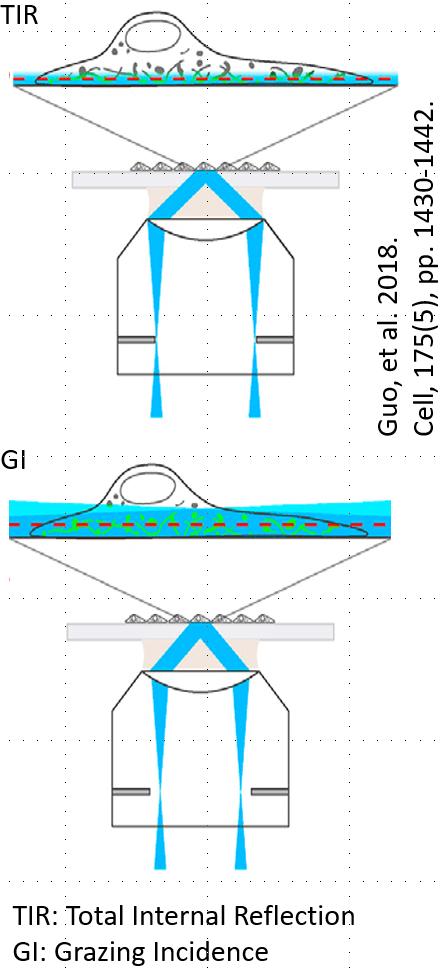
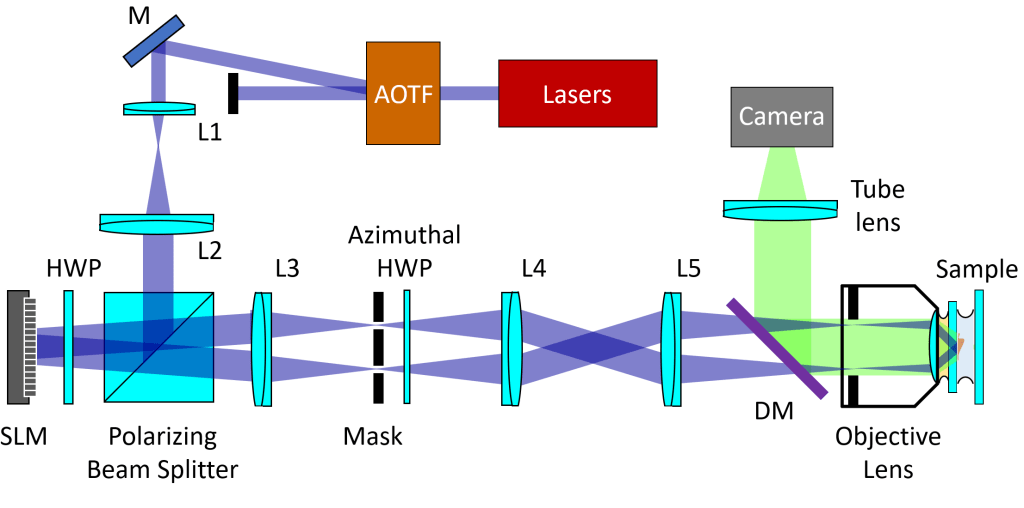
In structured illumination microscopy (SIM) the sample is illuminated with a spatially structured pattern with periodicity can be much smaller than half of the laser wavelength. By acquiring multiple images while shifting or rotating the illumination pattern and subsequently reconstructing them computationally, SIM improves the spatial resolution by up to a factor of two compared with conventional widefield microscopy. Furthermore, SIM can be combined with optical sectioning techniques, such as total internal reflection (TIR) and grazing incidence (GI) illumination, to further enhance image resolution and contrast.

Physical optics simulation

Beam propagation can be simulated using ray-based, wave-based, or hybrid approaches. Wave-based methods accurately account for diffraction effects arising from the interaction of electromagnetic waves with optical features whose dimensions are comparable to the wavelength. However, when diffraction effects are negligible, ray-based methods provide a computationally more efficient alternative while maintaining high accuracy. Hybrid approaches, which combine ray- and wave-based techniques, offer a practical compromise by efficiently incorporating diffraction effects only where necessary, thereby enabling faster simulations without sacrificing accuracy.
 Structured Beam Optics Laboratory (SBOL)